- by foxnews
- 23 Jun 2026
The pandemic exposed the human cost of the meatpacking industry?s power: ?It?s enormously frightening?
The pandemic exposed the human cost of the meatpacking industry’s power: ‘It’s enormously frightening’
- by theguardian
- 17 Nov 2021
- in news
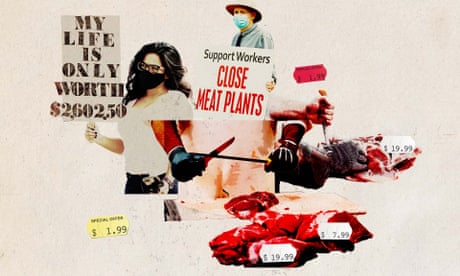
Early in the pandemic, Covid outbreaks were rampant in America’s meatpacking plants - the factories that kill, cut and package animals.
But the chairman of one of biggest meat companies in the US, Tyson, argued that these factories should stay open to feed Americans.
The following month, 49 meatpacking workers died of Covid.
The message was clear: Americans needed meat, and workers needed to risk their lives to provide it. And Osha - the labor department agency that is supposed to protect workers - could seemingly do little to protect them.
In a factory in Greeley, Colorado, owned by meat conglomerate JBS, at least six workers died early in the pandemic. Osha is supposed to investigate every workplace fatality reported to them, but it took months for them to send an investigator.
That’s about how much revenue JBS earns in 60 seconds.
Meatpacking workers tried to tell Osha about their concerns. In the first weeks of the pandemic, dozens of them officially complained to Osha. They said management was forcing people with Covid symptoms to continue coming to work; that social distancing guidelines weren’t enforced; and that they had inadequate protective equipment.
In a way the companies were right: it was unavoidable - partly because, for decades, the meatpacking industry had worked to take bargaining power away from workers to create an industry that has been criticized for treating them as disposable parts of an assembly line.
The failures weren’t limited to factories. The 500,000 people working in meatpacking inevitably came in contact with people in their community and spread the virus. Researchers found that by July 2020, areas nearby meatpacking plants had far more Covid cases and deaths than expected: about 5,000 additional Covid deaths and about a quarter million additional cases.
The modern meatpacking industry runs on human workers repeating the same motion, over and over, regardless of how much their bodies tell them to stop.
Each year, American meatpacking workers kill, cut and package about 9.3 billion chickens, 34 million cows and 130 million pigs. The numbers are too big to imagine. But in order to process that much meat, the USDA allows poultry companies to push 140 birds per minute through their lines - a number that was increased to 175 during the pandemic. That means some workers perform up to 24,000 knife cuts and lift 15 tons of meat each day, according to research estimates.
When Osha collected data on repetitive stress injuries, meatpacking companies consistently reported the highest rates of any industry. But in 2001, the agency stopped collecting such detailed data, removing the column that classified injuries as musculoskeletal disorders.
Osha said that repetitive stress injuries are still reported in Osha logs, but a 2016 GAO report found that that information is in a separate incident report that is generally not sent to Osha or the Bureau of Labor Statistics, making it difficult to gather and track. Osha also said the Bureau of Labor Statistics collects data on repetitive stress injuries; however that data is an estimate calculated from random surveys of employers.
But a year later, Republicans rescinded the rule.
Meanwhile, managers keep workers on the lines. That can mean that many factories don’t allow workers to take bathroom breaks. A Southern Poverty Law Center survey found that nearly 80% of workers said they can’t use the bathroom when needed. Another survey in Minnesota found that 86% of workers said they get two or fewer bathroom breaks a week.
During the pandemic, keeping workers on the line meant forcing people with Covid to come to work, according to worker complaints to Osha.
Serious and traumatic injuries are also common. In 2015, Osha began requiring employers to report serious injuries promptly after the incident. This involves any injury that requires in-patient hospitalization, amputation of a body part, or loss of an employee’s eye. (Only the states under federal jurisdiction have to report.) And year after year, meatpacking workers are among the most likely to suffer an injury where a body part is amputated. About half of the injuries involve workers losing fingers.
In February, Hussain Ahmed Jalal, an immigrant from Myanmar, was working at the JBS plant in Greeley at 12.40am - after most other workers had gone home.
The accident amputated his entire left hand.
Since the accident, he has gone through three different surgeries and is receiving workers’ compensation. He as worked at the factory since 2011, but he’s unsure when or if he will be able to return to work. Osha investigated the accident several months later and issued five safety penalties, according to Osha citations obtained by the Guardian.
The proposed penalty: $174,566.
The precarious work conditions in meatpacking - and lack of labor protections - were decades in the making, and often engineered to be this way.
When Osha was created in 1971, lawmakers assumed labor unions would play a large part in keeping companies in check. In addition, competition in the job market would allow workers to move to another company with safer labor practices, especially since meatpacking plants were clustered in dense urban areas.
But a handful of meatpacking companies had an idea of how to increase their power and maximize profits.
They first started moving meatpacking plants away from large cities and into rural areas where they would typically be the primary economic driver in the region. This gave them immense political power that still lives on to this day. For example, in Greeley, JBS employs nearly 4,600 workers, which accounts for about 10% of working adults in the town.
And those new powerhouses - Cargill, JBS, Tyson and National - started buying up smaller companies. These companies kept on pointing to their decreasing injury stats to show that their workplaces were getting safer.
Those four companies now control 85% of the beef market and 70% of the pork market.
In addition to the geographic restructuring, these companies started to recruit a workforce that had less organizing power.
Meatpacking used to be dominated by native-born white and Black workers. But starting in the 1980s, the industry started to rely more and more on immigrant labor. In 1990, only about 18% of meatpacking workers were Hispanic. Just 10 years later, about 42% were Hispanic.
This coincided with the conservative attack on labor unions and the subsequent demise of an organized workforce.
In 1952, about 90% of meatpacking workers were covered under union contracts. By 1983, union membership had plummeted to 33% and by 2020 it was just 18%.
Meatpacking was once a middle-class job for citizens, with the average production worker in 1974 earning more than $25 an hour in 2021 dollars. But the active recruitment of workers with less organizing power allowed these wages to plummet.
During the Great Recession in 2008, wages fell to about $16 an hour. Now it’s about $19 an hour. But that’s the average; many meatpacking workers are paid far less. About one in five meatpacking workers are food stamp recipients, double the amount from 20 years ago, according to US census microdata.
And the ultimate goal for all of this was to improve the bottom line.
While consumers have been paying more for meat and the farmers who raise these animals have been paid less, these meatpacking giants have profited. In 2017, the top four meatpacking companies had a combined annual revenue of $207bn.
This year, the biggest of those companies, Cargill, brought in record profits, making $4.3bn in the first nine months of this fiscal year.
For decades, there have been reports of meatpacking companies urging their workers to not report injuries.
In the past, the labor department used to collect data on repetitive trauma injuries. But in the early 2000s, Osha stopped requiring employers to collect this data separately, which made it look like overall workplace injuries were plummeting - something industry groups would boast about year after year.
But even when Osha collected that data, it may have been a severe undercount. When the Southern Poverty Law Center surveyed hundreds of meatpacking workers in Alabama, they found that 66% of respondents said they suffered from symptoms of these repetitive motion injuries, like chronic pain, swelling and numbness.
Notably, Osha collects comprehensive data only from the 29 states that are under its jurisdiction. All other states police themselves.
Meanwhile the number of Osha inspectors is at the lowest number since the early 1970s, after the Trump administration slashed the agency’s resources.
There are only 1,815 inspectors (752 federal and 1,063 state) to inspect the 9.8m workplaces under Osha’s jurisdiction. Under current federal Osha staffing, the agency is only able to inspect workplaces under its jurisdiction once every 165 years on average.
Osha even struggled to count the number of meatpacking Covid deaths, according to a report by the House select subcommittee on the coronavirus crisis.
Osha reported 92 deaths in 2020. But one Osha official told the subcommittee that they relied in part on data from the Food and Environment Reporting Network, a nonprofit news organization, which counted more than 260 deaths in 2020.
About one month after Hussain Ahmed Jalal lost his hand in an accident this year, another accident happened at the Greeley JBS plant.
Jonathan Bryan Duerst, a 55-year-old worker, was knocked over by a piece of equipment and fell into a vat of chemicals used to process animal hides. Duerst died.
Osha investigated and found eight serious violations that contributed to his death. The result: a proposed fine of $58,709.
Last year, the average American consumed about 225 pounds of meat.
you may also like

- by foxnews
- 23 Jun 2026
Popular mommy blogger dies at 48 two years after devastating cancer diagnosis

travel
- by foxnews
- descember 09, 2016
Terrifying scene unfolds as metal cabana frame crashes into packed casino pool area
A metal cabana frame reportedly crashed into a crowded pool area at the Seminole Hard Rock Hotel & Casino in Hollywood, Florida, injuring five people Saturday.
read more