- by foxnews
- 16 Jul 2026
Hidden underground chamber revealed beneath home of legendary Roman emperor
Archaeologists recently found Roman concrete vault impressions and ceramic artifacts inside a sealed chamber predating Emperor Hadrian's imperial complex.
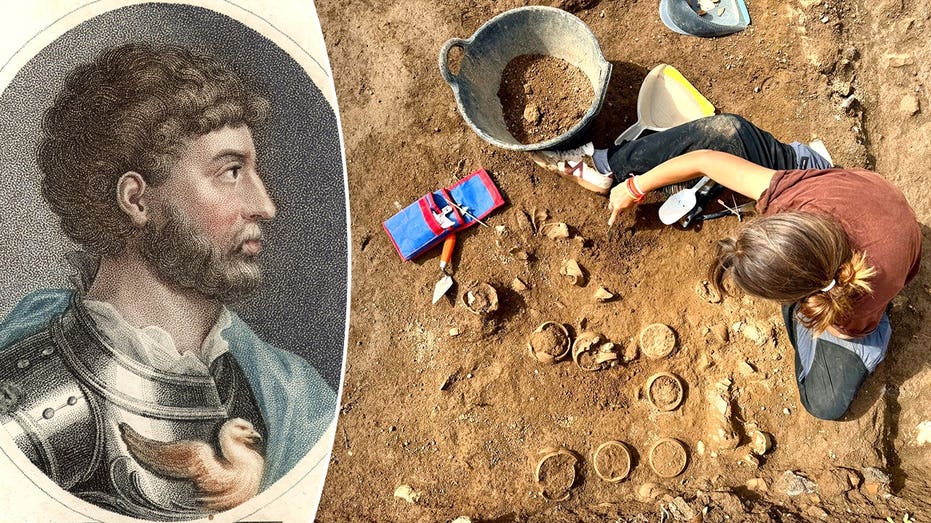
The discovery, made at Hadrian's Villa in Tivoli, Italy, was recently announced by Pablo de Olavide University (UPO), a university in Seville, Spain.
The emperor is best known for building Hadrian's Wall in northern Britain and traveling throughout the Roman Empire during his reign.
The abandoned structure, which officials believe may have been used as a silo or storage facility, was partially filled in with ancient construction debris and ceramic materials.
The find "could prove to be the oldest structure ever identified at Hadrian's Villa," officials said.
Much of that earlier complex was destroyed during construction of the emperor's sprawling villa, leaving archaeologists with few clues about its history.
"The discovery is particularly significant because it is associated with a villa that predated Hadrian's imperial residence and was later partially incorporated into the construction of the Palazzo," the statement added.
It was surprising to see that the structure was not completely filled with soil, said Rafael Hidalgo, director of the Palazzo Project at Hadrian's Villa.
Hidalgo told Fox News Digital that more surprises came when his team began excavating the space's interior. They found objects that "provide highly valuable information for understanding the history of Hadrian's Villa," he said in an email translated from Spanish to English.
"The recovery of a significant assemblage of archaeological materials from inside the structure ... will allow us, once the ongoing study is completed, to propose a date for this archaeological context," he said.
Archaeologists found several ceramic pieces along with architectural terracottas that once lined the roof of a nearby building.
Several of the terracottas featured canine heads, while one depicted a bull's head.
Hidalgo said the structure is in "excellent condition," especially its vaulted roof, which is relatively fragile and typically collapses.
The roof "was perfectly preserved," he said.
"Even on the inner surface of the vault, the impressions left by the wooden centering - the timber framework used during construction - are still clearly visible," said Hidalgo.
"These supported the opus caementicium [or] Roman concrete, as it was poured to create the vault."
The archaeologist said the discovery helps fill a longstanding gap in what experts know about the villa that existed before Hadrian's.
"We have relatively little information about this earlier villa because much of it was destroyed by Emperor Hadrian during the construction of his own complex," Hidalgo said.
The find adds to a growing list of underground archaeological discoveries that provide insight into ancient Rome.
you may also like

- by foxnews
- 16 Jul 2026
Major airline roasts passengers who jump up right after landing, igniting fierce backlash

- by foxnews
- 16 Jul 2026
Las Vegas prices squeeze everyday travelers as popular city embraces expensive makeover



travel
- by foxnews
- descember 09, 2016
Tourist's church clothing hack leaves travelers sharply divided over sacred-site etiquette
A viral TikTok video shows a traveler layering on a skirt and scarf before entering churches in Italy, sparking heated debate over tourist etiquette at sacred sites.
read more